Table of contents
Keep your kitchen running smoothly
Send orders straight to the kitchen, reduce mistakes and help your team serve guests faster with YUMA KDS.
If you run a café, restaurant, pub, bakery or takeaway, you’ve almost certainly heard the term “EPOS” thrown around — usually by a salesperson, sometimes by another operator, occasionally by your accountant. But what does it actually mean, and does it matter for a business your size?
Here’s the plain-English answer, no jargon required.
What does EPOS actually stand for?
EPOS stands for Electronic Point of Sale. Strip away the acronym and it’s simply the system your business uses to take payment and manage a sale — the modern, connected version of a cash till.
The “electronic” part is what makes the difference. A traditional till adds up totals and opens a drawer. An EPOS system does that too, but it also talks to everything else in your business: your kitchen, your stock levels, your staff rota, your sales reports, and often your online orders as well.
What’s actually inside an EPOS system?
“EPOS” isn’t one single piece of kit — it’s a handful of connected parts working together:
The till itself. Where orders are taken and payments processed, whether that’s at a counter, a table, or a self-serve kiosk.
Back office. The operational hub behind the scenes — menus, pricing, staff permissions and settings, all managed from one place rather than scattered across notebooks and spreadsheets.
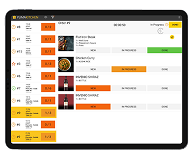
Kitchen display or ticket system. Orders sent straight to the kitchen the moment they’re taken, cutting out handwritten tickets and the errors that come with them.
Payments. Card and contactless payment processing built into the same system that’s taking the order, rather than a separate card machine doing its own thing.
Reporting. Sales, stock and staff data pulled together automatically, so you can see what’s actually happening in your business without totting up receipts at midnight.
Some systems bundle in more — online ordering, loyalty schemes, multi-site reporting — but at its core, that’s what EPOS means: the parts of your business that handle a sale, connected rather than separate.
Where the more capable EPOS systems go further
Everything above is table stakes — the basics you’d expect from any EPOS system worth the name. But there’s a real difference between a system that just processes sales and one that actively helps you grow, and it comes down to three things:
Marketing that runs itself. A basic till has no idea who your regulars are. A more capable system builds a customer CRM automatically from the sales you’re already taking, then lets you run loyalty schemes, email and SMS campaigns, and targeted offers off the back of it — without a separate marketing platform to manage.
Reporting that shows you the whole picture. Basic reporting tells you what sold today. Proper reporting shows you menu engineering insights (which dishes make you money and which just take up space), labour costs against sales in real time, and — if you’re running more than one site — performance across every location side by side, not five separate spreadsheets stitched together at month-end.
Delivery and ordering that doesn’t hand your margin to someone else. Third-party delivery apps take a cut of every order, sometimes a substantial one. A properly built EPOS system gives you your own commission-free online ordering — branded website, app, QR code and click & collect — so growth in delivery and takeaway doesn’t automatically mean growth in fees.
This is really what separates a basic till replacement from a genuine growth partner: not just recording what happened, but giving you the tools to bring customers back, see your business clearly, and keep more of what you earn.
Why does this matter for an independent business specifically?
Larger chains have IT teams, dedicated support desks and the budget to bolt together whatever software they need. Independent hospitality businesses don’t have that luxury — which is exactly why a disconnected setup costs you more, not less.
If your till, your stock system, and your online orders don’t talk to each other, someone on your team is doing that job manually — checking three places to see what’s sold, re-typing menu changes into two different systems, chasing numbers at the end of a shift instead of seeing them in real time.
A proper EPOS system removes that manual step. One sale, recorded once, visible everywhere it needs to be. It’s a problem that only grows if you’re running more than one site — disconnected systems that were merely annoying at one location become genuinely costly across several.
Do you actually need one?
If you’re taking payments by hand, working from a paper-based till, or juggling separate systems for ordering, stock and reporting, the honest answer is: it’ll save you time almost immediately. If you already have an EPOS system but it still feels disconnected — separate logins, separate reports, nothing talking to anything else — the problem isn’t EPOS itself, it’s that yours isn’t doing the “connected” part properly.
That’s really the difference between EPOS systems worth having and ones that aren’t: not whether they exist, but whether they’re actually joined up.
The takeaway
EPOS isn’t a buzzword — it’s simply the system that runs the sale side of your business, done properly. Till, kitchen, stock, payments and reporting, working as one instead of five separate headaches.
If you’re weighing up whether your current setup is pulling its weight, or you’re choosing a system for the first time, it’s worth judging any EPOS provider on one question: does this genuinely connect everything, or does it just add another login to your day?
For wider context on the pressures facing UK hospitality businesses right now, UKHospitality — the sector’s trade body — is a useful resource, particularly if you’re looking at the bigger picture beyond tech.
Want to see what a properly connected EPOS system looks like in practice? Book a demo with YUMA and we’ll show you around.