Table of contents
Keep your kitchen running smoothly
Send orders straight to the kitchen, reduce mistakes and help your team serve guests faster with YUMA KDS.
Ask most independent operators what’s in their “tech stack” and you’ll get a shrug, not a shopping list. But every café, restaurant, pub or takeaway has one whether they’ve named it or not — it’s just the collection of systems that gets a customer fed, paid, and marketed to again. The question isn’t whether you have a tech stack. It’s whether the pieces are actually talking to each other.
Here’s what a hospitality tech stack is really made up of, what a typical one looks like in practice, and where it tends to fall apart.
The building blocks: what every hospitality business actually needs
Strip it back, and there are really only five things any hospitality tech stack has to do:
Take the sale. Your till or EPOS system — the point where an order becomes a transaction.
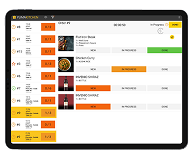
Run the kitchen. However orders get from counter or table to the person cooking them — a kitchen display system, a ticket printer, or (still, in a lot of places) someone shouting.
Take orders beyond the counter. Online ordering, click & collect, delivery — however customers reach you when they’re not stood in front of you.
Bring customers back. Loyalty, customer data and marketing — the systems that turn a one-off visit into a regular.
Show you what’s happening. Reporting across sales, stock and staff, ideally in one back office rather than scattered across notebooks, spreadsheets and someone’s memory.
That’s the blueprint. Every hospitality business, from a single-site café to a ten-site group, needs some version of all five. What changes is how joined up they are.
What this actually looks like in most independent businesses
In practice, that blueprint rarely shows up as one clean system. It’s more often five separate ones, bought at different times for different reasons:
- A till bought years ago, doing the bare minimum
- A card machine sat next to it, doing its own thing entirely
- A tablet for Deliveroo, another for Uber Eats, each with its own menu to update by hand
- A spreadsheet for stock, updated (optimistically) once a week
- A WhatsApp group standing in for a proper rota and shift handover
None of that is a criticism — it’s how most independent hospitality businesses grow, bolting on a new tool each time a new problem shows up. The trouble is what it costs once it’s all in place: menu changes typed into four places instead of one, sales figures that don’t match across systems, and staff time spent reconciling numbers by hand instead of running the floor.
Where a connected stack changes things
A properly connected stack doesn’t mean fewer capabilities — it means the same five building blocks, sharing data instead of duplicating it. A menu change made once, live everywhere. A sale recorded once, showing up in reporting, stock and loyalty automatically. One login instead of five.
That matters even more the moment you’re running more than one site — a multi-site operation magnifies every gap in a disconnected stack, because now it’s not one till and one spreadsheet out of sync, it’s five, with someone trying to make sense of all of them at head office.
The takeaway
Every hospitality business already has a tech stack, whether it’s been designed that way or grown by accident. The five building blocks — sales, kitchen, ordering, marketing and reporting — are non-negotiable. What separates a stack that helps from one that just adds admin is whether those pieces are actually connected, or just sat next to each other.
If you’re not sure which one describes your business, a good test is this: could you answer “what did we sell today, across every channel, without opening more than one screen?” If the answer’s no, that’s exactly where to start looking.
Curious what a genuinely connected stack looks like for your business? Book a demo with YUMA and we’ll walk you through it.