Table of contents
See YUMA’s restaurant EPOS in action
Connect orders, kitchen operations, payments and back-office management with one EPOS system built for restaurants.
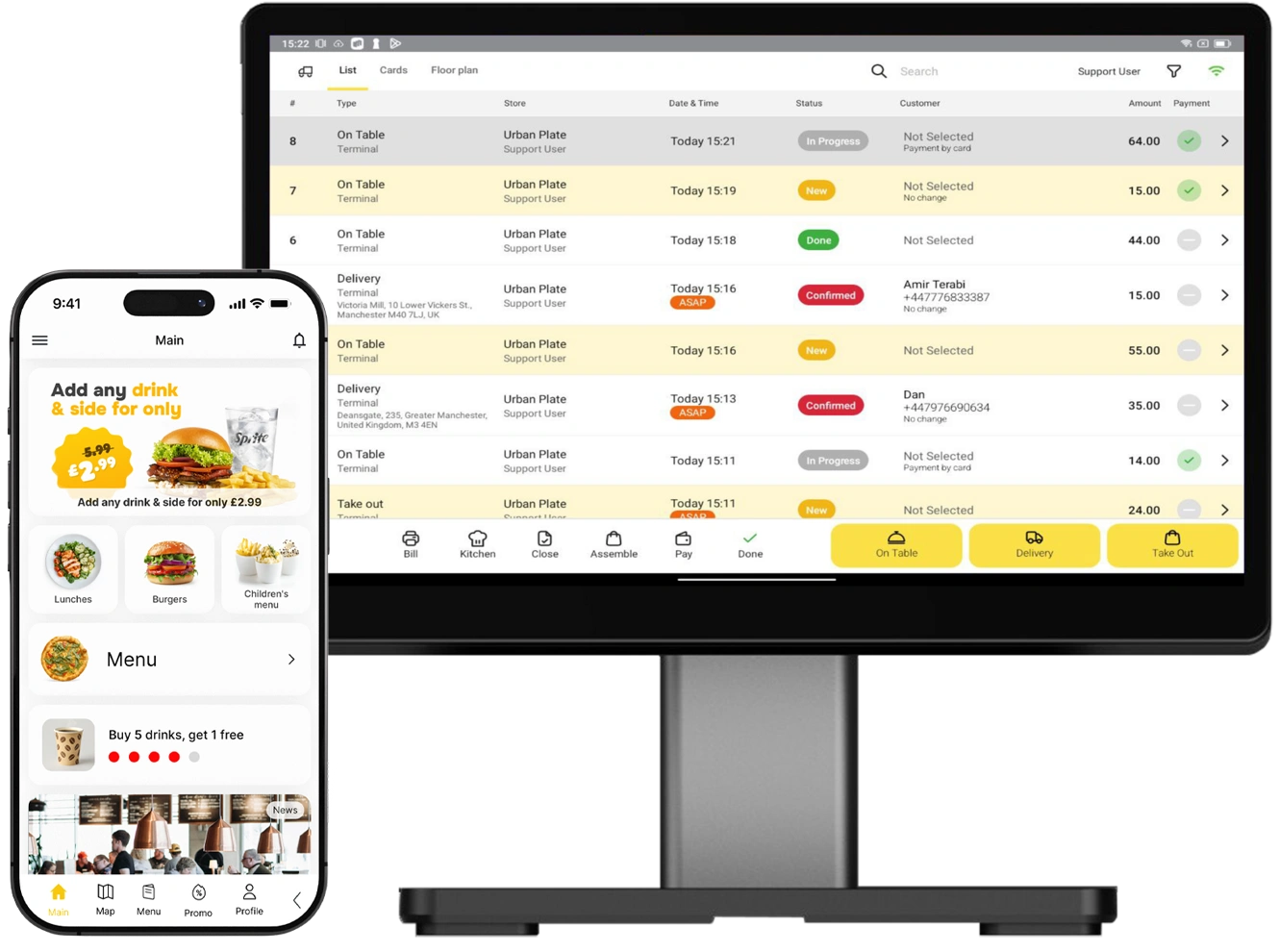
Generic EPOS comparison advice — check the pricing, ask about support, look at reporting — applies to any hospitality business. But a full-service, table-based restaurant has needs a café, pub or takeaway simply doesn’t: course timing, splitting a table’s bill six ways, service charge handled correctly, reservations that connect to what actually happens on the night. If you’re comparing systems specifically for a restaurant, these are the questions worth asking that a generic checklist won’t cover.
If you’re comparing different systems, it’s worth seeing how the features work together in practice. Explore YUMA’s restaurant EPOS system to see how table management, kitchen operations and payments connect.
How precisely does it handle course timing?
In a restaurant, timing isn’t a nice-to-have — starters, mains and desserts need to reach the kitchen at the right moment, not all at once. Ask any provider to show you exactly how course management works: can a server hold back a course until the table’s ready, and does the kitchen see that timing clearly, or does everything just land in the same queue regardless of course?
How does it handle splitting a bill six different ways?
Retail and quick-service systems rarely need to split a single transaction across multiple people, multiple ways, on the spot. A table of six wanting to pay separately, or three couples wanting to split evenly, is a daily occurrence in full-service dining. Ask to see bill-splitting handled live, not described — by item, by seat, and evenly — and time how long it actually takes.
Does it handle service charge and tronc properly?
Discretionary service charge and tip distribution are a genuine compliance area for restaurants specifically, governed by the Employment (Allocation of Tips) Act 2023, which requires tips to be passed on fairly with clear records. Ask exactly how a system handles service charge, card tips and tronc distribution — and whether it keeps the records the law now requires, or leaves that entirely up to you to manage separately.
Do reservations and pre-orders actually connect to the floor?
Many restaurants take bookings and, increasingly, pre-orders — but a reservation system that doesn’t talk to the till means a table’s pre-order has to be re-entered by hand once they arrive. Ask specifically whether a booking or pre-order flows straight into the order that reaches the kitchen, or whether it’s a separate system your staff have to bridge manually.
How does front-of-house ordering actually work under pressure?
A handheld waiter app that works fine in a quiet demo can behave very differently on a packed Saturday night — slow to sync, awkward to search a long menu on, or clunky when modifying an order table-side. Ask to try it yourself, specifically under conditions that mimic a busy service: fast order entry, quick modifiers, and immediate transfer to the kitchen.
The takeaway
A generic EPOS comparison will tell you about pricing, support and general reporting — all useful, but none of it restaurant-specific. The questions that actually separate systems for full-service dining are the ones above: course timing precision, real bill-splitting, proper tronc handling, reservations that connect to the floor, and front-of-house ordering that holds up under real pressure. Ask providers to show you each of these directly, rather than describe them.
Ready to put YUMA to the test?
Explore our restaurant EPOS system to see how YUMA supports table service, kitchen operations, payments and restaurant management. Then feel free to book a demo to see how it works during a real restaurant service.