Table of contents
Run a smarter, more profitable cafe
Track sales, manage stock and spot opportunities to improve your margins with YUMA EPOS for cafes.
Your café might be busy from opening until closing, with a steady stream of coffees, sandwiches and cakes going across the counter. But when you look at your bank balance at the end of the month, are you actually making as much money as you think?
High sales don’t always mean high profits. Once you’ve paid for ingredients, staff, rent, energy and everything else involved in running your café, what’s left can be surprisingly small.
Understanding your café’s profit margins helps you see which products are making money, where costs are creeping up and what you can do to improve your bottom line.
And the good news? You don’t need to be an accountant to work it out.
What is a café profit margin?
Your profit margin is the percentage of your sales revenue that remains after certain costs have been deducted.
For example, if your café makes £10,000 in sales and keeps £1,000 as profit after all relevant costs, that’s a 10% net profit margin.
There are two main types of profit margin worth understanding: gross profit margin and net profit margin.
Gross profit margin
Gross profit is what you have left after subtracting the direct costs of the products you’ve sold.
For a café, this typically includes coffee beans, milk, syrups, bread, sandwich fillings, cakes and other ingredients. Packaging directly associated with sales may also be included, depending on how you categorise your costs.
The formula is:
Gross profit margin (%) = (Revenue − Cost of goods sold) ÷ Revenue × 100
Let’s say you sell a latte for £3.60, excluding VAT, and the coffee, milk, cup and other direct product costs come to 90p.
Your gross profit is £2.70.
£2.70 ÷ £3.60 × 100 = 75% gross profit margin.
That means 75% of the selling price remains to cover staff wages, rent, utilities and other operating expenses before you make a final profit.
For consistency, use sales figures excluding VAT and the corresponding costs excluding recoverable VAT. If you’re VAT-registered, remember that the amount a customer pays isn’t necessarily all business revenue.
Net profit margin
Net profit margin gives you a broader picture of how profitable your café actually is.
It takes into account the other expenses involved in running your business, including:
- Staff wages and employer costs
- Rent and business rates
- Electricity, gas and water
- Insurance and software subscriptions
- Marketing and administration
- Equipment maintenance and other overheads
The formula is:
Net profit margin (%) = Net profit ÷ Revenue × 100
For example, if your café generates £20,000 in revenue, excluding VAT, and has £18,000 in total expenses, you’re left with £2,000 in net profit.
£2,000 ÷ £20,000 × 100 = 10% net profit margin.
This simplified example treats net profit as the amount remaining after all operating expenses, depreciation, interest and other relevant costs, but before corporation or personal tax.
Gross profit tells you how much your products contribute towards running the business. Net profit tells you how much remains once the wider costs are accounted for.
What is a good profit margin for a café?
There’s no single profit margin that every café should aim for.
A small independent coffee shop with limited seating will have a very different cost structure from a large café serving cooked breakfasts and lunches.
Your margins will depend on factors such as location, rent, staffing, menu prices, ingredient costs and how much food you prepare on-site.
Coffee and other drinks can offer attractive gross margins because their ingredient costs are relatively low compared with their selling prices. Freshly prepared food may have higher ingredient costs, more preparation time and greater potential for waste.
Industry benchmarks can provide a useful starting point, but they shouldn’t be treated as universal targets.
For example, the UKHospitality and Christie & Co benchmarking report provides gross margin comparisons across hospitality segments. These aren’t café-specific figures, but they demonstrate how margins vary between different types of hospitality business.
The most useful comparison is often your own café’s performance over time.
If your gross margin was 72% last quarter but has fallen to 65%, it’s worth investigating what changed. Have ingredient prices increased? Are portions getting larger? Have you introduced discounts that aren’t generating enough additional sales?
Knowing your numbers helps you spot these changes before they become bigger problems.
How to calculate your café’s monthly profit
Let’s put the formulas into practice.
Imagine a small independent café generating £20,000 in monthly sales, excluding VAT.
Here’s a simplified breakdown of its costs.
| Monthly income and expenses | Amount |
| Sales revenue | £20,000 |
| Ingredients and packaging | £6,000 |
| Gross profit | £14,000 |
| Staff wages and employer costs | £6,000 |
| Rent and business rates | £2,000 |
| Utilities | £700 |
| Insurance, software and other overheads | £1,300 |
| Operating profit | £4,000 |
Illustrative figures only. This example excludes depreciation, interest, tax and other costs that may apply to an individual business.
Step 1: Calculate gross profit
Subtract your direct product costs from revenue.
£20,000 − £6,000 = £14,000
Your gross profit margin is:
£14,000 ÷ £20,000 × 100 = 70%
Step 2: Calculate operating profit
Now subtract your other operating expenses.
£14,000 − £10,000 = £4,000
Your operating profit margin is:
£4,000 ÷ £20,000 × 100 = 20%
That leaves £4,000 before any additional costs excluded from this example.
In reality, your figures will vary month to month. A quieter January, an increase in milk prices or additional staffing during the summer could all affect your results.
The important thing is to calculate your margins regularly rather than waiting until the end of the financial year.
Why high sales don’t always mean high profits
It’s easy to focus on revenue when you’re running a café.
After all, a busy counter and a growing number of transactions generally feel like positive signs.
But increasing sales doesn’t always mean you’re making more money.
Imagine you introduce a promotion offering 20% off all sandwiches.
You might sell considerably more sandwiches, but if the discount reduces your margin too far, the extra sales may not generate enough profit to justify the promotion.
The same applies to popular products with expensive ingredients or high levels of waste.
A cake that sells out every day might look like a success. But if the ingredients, packaging and unsold portions from each batch cost more than expected, it may contribute less profit than another item selling in smaller quantities.
This is why it’s worth looking beyond your best-selling products and understanding how much each one contributes to the business.
Five ways to improve your café’s profit margins
Once you understand your current margins, you can start looking for opportunities to improve them.
Small adjustments across your menu, stock management and daily operations can make a meaningful difference.
1. Review your menu pricing
When was the last time you calculated how much each item on your menu actually costs to make?
Ingredient prices change, but menu prices don’t always keep up.
Work out the cost of your most popular products, including ingredients, portions and relevant packaging.
Compare these costs with the selling price to identify items with particularly low margins.
You don’t necessarily need to increase every price. You might be able to adjust portion sizes, change suppliers or review ingredients without affecting the customer experience.
Just make sure any changes maintain the quality customers expect.
2. Reduce food waste
Every unsold sandwich, expired carton of milk or discarded pastry represents money your café has already spent.
Start tracking what gets thrown away and why.
Are you preparing too many sandwiches before the lunchtime rush? Are certain cakes regularly left over? Are ingredients expiring because you’re ordering more than you need?
Even a simple daily waste log can help identify patterns.
Over time, you can use that information to adjust ordering quantities, preparation schedules and menu choices.
3. Increase average customer spend
Getting customers to spend a little more on each visit can help increase revenue without needing to attract significantly more people through the door.
Think about the products that naturally go together.
A customer buying a coffee might also want a pastry. Someone ordering a sandwich might be interested in adding a drink.
You could try breakfast bundles, meal deals or relevant add-ons, provided the offers still leave you with a healthy margin.
The aim isn’t to pressure customers into spending more. It’s to make useful combinations easy to find and order.
4. Match staffing to demand
Staffing is one of the biggest operating expenses for many cafés.
Having too few people working during busy periods can lead to longer queues and lost sales. But having too many staff during quieter hours can increase costs unnecessarily.
Look at when your café is busiest throughout the day and week.
If most of your sales happen between 8am and 11am, your rota should reflect that demand.
Historical sales reports can help you identify patterns and make more informed staffing decisions while maintaining appropriate cover, breaks and service standards.
5. Keep a closer eye on stock
Stock control isn’t just about knowing when you’re running low on coffee beans.
It’s also about understanding how much you’re using, what you’re spending and whether your actual usage matches your sales.
For example, if you’re selling 200 lattes a week, you should have a reasonable idea of how much milk those drinks require.
If you’re consistently using much more than expected, there could be issues with portion control, spillages, waste or stock recording.
A café EPOS system with ingredient-level stock tracking can help you connect sales with stock usage and identify discrepancies more easily.
How your café’s sales reports can help improve profitability
You don’t need to spend hours working through spreadsheets every evening to understand how your café is performing.
The right sales information can help you make better decisions throughout the week.
Some of the most useful figures to monitor include:
- Total revenue: How much your café is taking each day, week and month.
- Average transaction value: How much customers typically spend per visit.
- Best-selling products: Which drinks and food items are most popular.
- Product margins: Which items contribute the most gross profit, not just the most sales.
- Sales by time of day: When your café is busiest and when demand drops.
- Stock usage: Whether ingredient consumption matches the products you’ve sold.
Reviewing these figures together is more useful than looking at sales totals alone.
For example, a product might generate plenty of revenue but have a relatively low gross margin. Another might sell fewer units but contribute more profit per sale.
Similarly, knowing your busiest hours can help you plan staff rotas, preparation and stock levels more effectively.
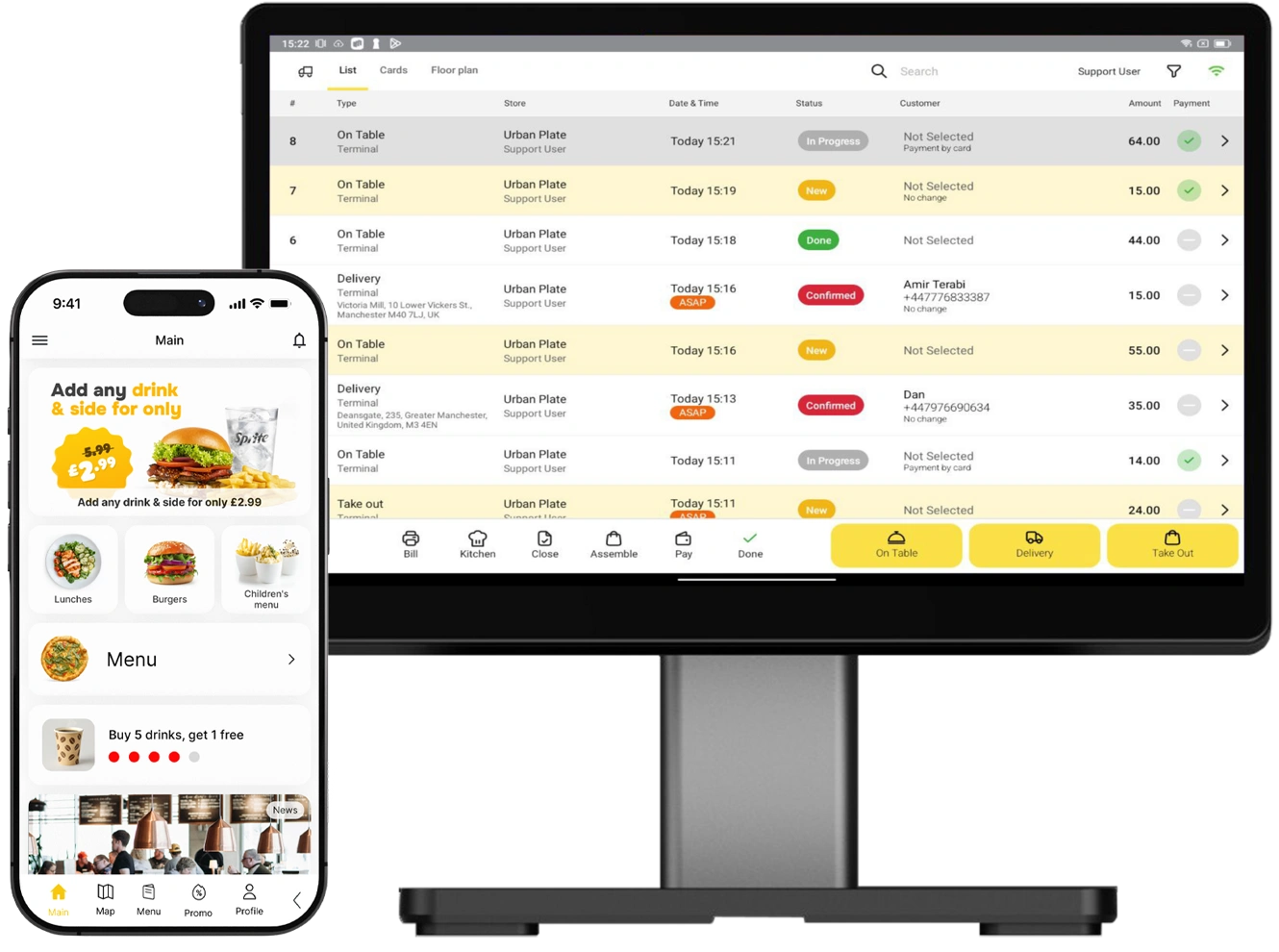
With YUMA’s café EPOS system, you can bring sales reporting, menu management and stock tracking together, making it easier to understand what’s happening across your business.
How often should you check your café’s profit margins?
You don’t need to calculate every financial metric every day, but regular reviews will help you stay on top of changes.
A useful routine is:
Daily: Check sales, transaction numbers, average spend and any unusual waste.
Weekly: Review product performance, ingredient usage, staffing costs and changes in sales patterns.
Monthly: Calculate gross and operating profit margins, review your overheads and compare performance against previous months.
It’s also worth reviewing your menu costs whenever suppliers increase their prices or you make significant changes to your recipes.
For VAT-registered cafés, remember to account for VAT correctly when calculating revenue and costs. The rules can vary depending on whether food is eaten on-site, taken away hot or sold cold. You can find the details in HMRC’s guidance on catering, takeaway food and VAT.
If you’re unsure how particular costs or taxes should be treated, speak to your accountant.
Small improvements can make a big difference
Improving your café’s profit margins doesn’t necessarily mean increasing prices or cutting costs wherever possible.
Sometimes it’s about making better use of the information you already have.
Understanding which products make money, where waste occurs and when your café is busiest gives you a clearer picture of how your business is performing.
From there, you can make smaller, more informed changes rather than relying on guesswork.
Because a busy café is great, but a busy café that’s actually making money is even better.
Know your numbers. Run a more profitable café.
From real-time sales reporting and menu management to ingredient-level stock tracking, YUMA EPOS gives you the tools to understand your café’s performance and make more informed decisions.