Table of contents
Take more orders directly
Give customers an easy way to order directly from your business, with your own online ordering system.
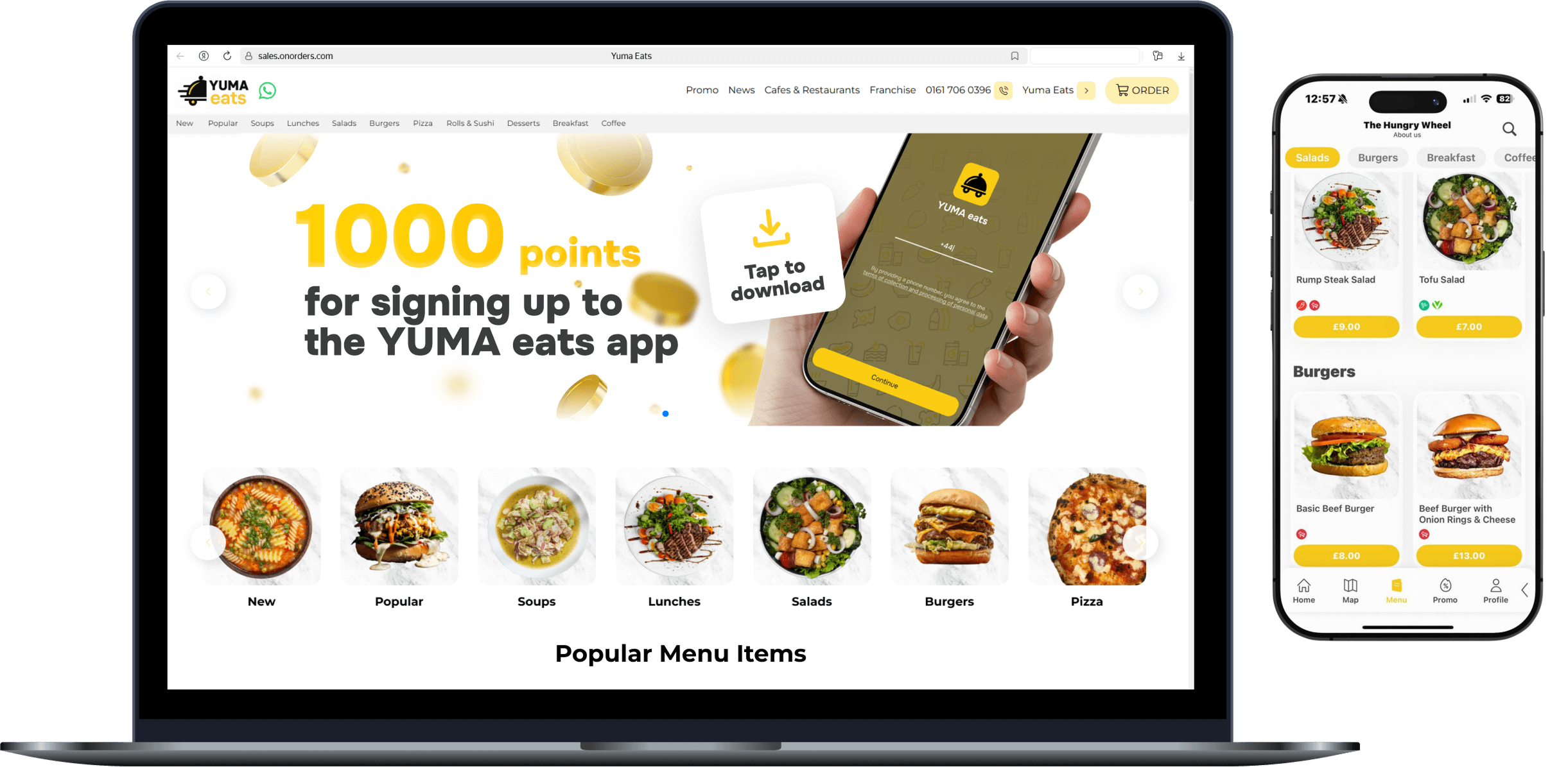
You’ve built your takeaway website, uploaded your menu and switched online ordering on. There’s just one problem: when your customers want to order, they’re still opening Deliveroo, Uber Eats or Just Eat.
That’s not particularly surprising.
Delivery apps are convenient. Customers already have them installed, their payment details may be saved and ordering through them is a familiar habit. Simply giving customers the option to order directly doesn’t mean they’ll automatically start using it.
Getting more direct orders means making customers aware that they can order from you directly, giving them a reason to do it and making the experience convenient enough that they’ll want to do it again.
Here are 10 practical ways to get more customers ordering directly from your takeaway.
Why don’t customers automatically order directly?
Think about the process from your customer’s perspective.
It’s Friday evening and they’ve decided they want a takeaway. They already have a delivery app on their phone, so they open it, find your business and place an order.
They might never think to search for your website.
Even customers who have ordered from you several times may not know you have your own online ordering system.
There are a few common barriers:
- They don’t know direct ordering is available
- They’re used to ordering through a particular delivery app
- Their account and payment details are already saved
- They originally discovered your takeaway through a marketplace
- They don’t see a reason to change how they order
- Finding your direct ordering page feels like more effort
You’re therefore trying to change an established customer behaviour.
To do that, focus on four things: visibility, convenience, incentive and repetition.
1. Put your direct ordering link everywhere customers can find you
Start by making sure customers can actually find your direct ordering system.
Your Order Online button should be one of the most prominent calls to action on your website, particularly on mobile.
But don’t stop with your website.
Look at every digital place where customers interact with your business and ask whether there’s an obvious route to ordering.
That could include your:
- Google Business Profile
- Instagram bio
- Facebook page
- TikTok profile
- Email marketing
- Email signatures
- Link-in-bio page
- Other local business listings
Your Google Business Profile is particularly important. Google allows food businesses to add ordering links to their profile and choose a preferred provider for pickup or delivery. That can give customers finding you through Google Search or Maps a route to your direct ordering system without needing to find your website first.
The fewer steps between someone deciding they want your food and reaching your menu, the better.
Don’t send someone to a generic homepage if you can send them directly to the page where they can start an order.
2. Promote direct ordering inside your delivery orders
One of your best opportunities to generate future direct orders comes from the orders you’re already receiving.
Think about someone receiving an order from your takeaway through Deliveroo, Uber Eats or Just Eat. They already know your business, they’ve chosen your food, and they’ve demonstrated that they order takeaway.
That makes them a highly relevant audience for promoting your direct ordering option.
Consider including something with fulfilled orders such as a:
- Flyer
- Thank-you card
- Menu
- Sticker
- Business card
- QR code
The message doesn’t need to be complicated:
Enjoyed your order? Order directly from us next time at [your website].
You can make that proposition stronger by giving them a reason to try it, such as a direct-order offer or loyalty reward.
Before including promotional materials with marketplace orders, check the current terms of the delivery platforms you use to ensure your approach complies with your agreements.
3. Give customers a reason to order directly
Ordering directly may be better for your business, but that’s unlikely to be enough to change your customer’s behaviour.
Ask a more important question:
What’s in it for them?
Price and value can play a part. YouGov research published in 2026 found that high service fees were the most commonly cited frustration with food delivery services, mentioned by 40% of British adults.
That doesn’t mean your direct channel simply needs to be cheaper. But offering customers better value through a direct-only bundle, free extra, loyalty reward or other incentive can give them another reason to change their ordering habit.
There are plenty of ways to make direct ordering more attractive without permanently discounting your entire menu.
You could offer:
- A direct-order discount
- A free side above a certain spend
- Exclusive meal bundles
- Direct-only menu items
- Free extras
- Loyalty points or rewards
- Limited-time promotions
Think carefully about the behaviour you’re rewarding. If customers can get the same food, at the same price, through the delivery app they’re already familiar with, there may be little reason for them to change. That doesn’t mean you need to be dramatically cheaper – sometimes a small extra benefit is enough to make ordering directly feel worthwhile.
Try to add value rather than relying entirely on blanket discounts that eat into your margin.
4. Use QR codes to make direct ordering easy
Telling customers to order directly is one thing. Making them type your website address into their phone is another.
A QR code removes several steps.
Customers scan it with their phone and arrive directly at your ordering page.
QR codes can be added to:
- Delivery bags
- Flyers
- Menus
- Receipts
- Counter displays
- Collection areas
- Shop windows
- Table displays
- Business cards
Wherever possible, send the customer straight to your online ordering page. Don’t make them scan a code, arrive on your homepage, find the menu, click another link and then start their order.
The ideal journey is:
Scan → choose food → order.
5. Turn collection customers into online customers
Delivery customers aren’t your only opportunity.
Someone collecting an order from your takeaway is already an existing customer. They know where you are, they know your food and they’ve deliberately chosen your business.
The collection experience is the perfect time to to tell them about direct online ordering.
A simple counter sign could say:
Ordering again? Skip the wait and order directly online next time.
You can also add your ordering URL or QR code to:
- Collection bags
- Receipts
- Printed menus
- Counter displays
Staff can mention it too, particularly if someone has ordered over the phone.
It doesn’t need to become a sales pitch. A simple “You can order through our website next time if that’s easier” is enough to make the customer aware that the option exists.
6. Make direct ordering genuinely convenient
Marketing can persuade someone to try your direct ordering system, but the experience determines whether they’ll use it again.
Customers have become accustomed to relatively smooth ordering experiences through major delivery apps. If your direct ordering website is confusing, slow or difficult to use on a phone, an introductory discount isn’t going to fix the underlying problem.
Test the entire experience yourself.
Look at:
- Mobile usability
- Page speed
- Menu navigation
- Product images and descriptions
- Modifier selection
- Collection and delivery options
- Payment methods
- Number of checkout steps
- Order confirmation
Better still, ask someone unfamiliar with the system to place a test order while you watch – where do they hesitate? What can’t they find? Which steps aren’t obvious?
The question to keep asking is:
Is ordering directly from us easy enough that a customer would choose to do it again?
If you’re still choosing your technology, our guide to what to look for in an online ordering system covers the features worth considering.
7. Give customers a reason to come back
Getting someone to place their first direct order is useful, but getting them to place their fifth, tenth and twentieth is much more valuable.
This is where loyalty can play an important role. Instead of treating every order as a separate transaction, consider how you can reward customers for repeatedly choosing your direct channel.
That might include:
- Points for direct orders
- Rewards after a certain number of purchases
- Spend-based rewards
- Free products
- Birthday rewards
- Exclusive offers for returning customers
A one-off discount might convince someone to try ordering directly – a good loyalty proposition gives them a reason to keep doing it.
This is also why you should think beyond simply comparing the cost of a direct order with the cost of a marketplace order. The bigger opportunity is building a direct relationship with customers who regularly order from you.
8. Use your customer data to encourage repeat orders
One of the advantages of direct ordering is the opportunity to build your own customer relationship.
With the appropriate marketing permissions, that can give you ways to communicate with customers after their first order.
For example, you could use email or SMS to promote:
- New menu items
- Weekend offers
- Seasonal specials
- New meal bundles
- Loyalty rewards
- Limited-time discounts
- Re-engagement offers
The aim shouldn’t be to message customers constantly. Instead, think about when your marketing is genuinely useful.
A message about a Friday night offer at 5pm is very different from sending generic promotional messages several times a week.
If you’re collecting customer information for marketing, make sure you’re following the relevant privacy and electronic marketing rules. The ICO’s guidance on electronic mail marketing explains the rules around marketing by email and SMS, including consent and when the existing-customer “soft opt-in” may apply.
Importantly, you shouldn’t assume that someone providing their email address or phone number to place an order automatically means you can use those details for marketing.
9. Use social media to drive direct orders
If you’re already spending time building an audience on Instagram, Facebook or TikTok, give that audience an easy route to becoming customers.
But don’t make every post:
ORDER DIRECT NOW!
Build direct ordering into content that already gives someone a reason to want your food.
For example:
Launching a new burger?
Show it, describe it and link directly to where customers can order it.
Running a weekend special?
Make the offer available through your direct ordering channel.
Friday afternoon?
Remind followers that dinner can be ordered in a few taps.
Big football match tonight?
Create a relevant meal bundle and direct customers to the ordering page.
Your content creates the demand while your direct ordering link gives the customer somewhere to act on it.
Make sure that link is easy to find when they do.
10. Make direct ordering part of your wider marketing
Direct ordering shouldn’t sit on its own as a separate project.
Look at the marketing you’re already doing.
That might include:
- Leaflet drops
- Paid social advertising
- Organic social media
- Google advertising
- SMS
- Local sponsorships
- Influencer campaigns
- Printed menus
- In-store promotions
For each campaign, ask:
Where are we sending the customer?
If someone sees an advert for a new meal deal, don’t make them search for your business afterwards.
Give them a clear route to order.
The same applies offline.
If you’re printing 5,000 leaflets, including a QR code that takes customers directly to your menu can turn that leaflet from simple awareness into an ordering route.
The direct ordering system should become the destination for your marketing rather than something customers are expected to discover by themselves.
Should you stop using Deliveroo, Uber Eats and Just Eat?
Not necessarily.
Direct ordering doesn’t need to mean abandoning the delivery apps. Marketplaces such as Deliveroo, Uber Eats and Just Eat can put your takeaway in front of customers who might not otherwise discover it. That reach is extremely valuable.
Direct ordering solves a different problem.
Once a customer already knows your business, you have an opportunity to build a more direct relationship with them and give them another way to order. A useful way to think about it is:
Delivery marketplaces can help customers discover you. Direct ordering can help you build the relationship afterwards.
The two can operate alongside each other.
If you’re using several delivery platforms, you can also reduce some of the operational complexity by bringing them together. Read our guide to managing Deliveroo, Uber Eats and Just Eat in one place for more on how delivery app integrations work.
We’ve also broken down the wider commercial differences in our guide to delivery app fees vs direct ordering.
How do you know if your direct ordering strategy is working?
Don’t judge your direct ordering system simply by whether orders are coming through it. Track whether you’re actually shifting customer behaviour over time. Some useful measures include:
Direct orders per month
Start with the simplest number. How many direct orders did you receive this month compared with last month?
If you’re actively promoting direct ordering, you should be able to see whether that activity is translating into orders.
Percentage of online orders placed directly
Raw order numbers don’t tell the whole story. If your takeaway is growing, direct orders might increase while their share of your total online orders stays the same.
Tracking the percentage of orders coming directly gives you a clearer picture of whether customers are actually changing how they order.
Repeat direct customers
How many customers place another direct order? If lots of customers use an introductory offer once but immediately return to a marketplace afterwards, look at the experience and incentives you’re providing after that first purchase.
Average order value
Compare how much customers typically spend through different ordering channels.
This can help you understand whether bundles, minimum-spend offers, modifiers and other promotions are changing customer behaviour.
Offer and QR code redemptions
If you’re using promotional codes or trackable QR codes, use them to understand where direct customers are coming from.
For example, you could use different campaigns for:
- Delivery bag inserts
- Collection counter
- Printed leaflets
- SMS
That allows you to identify which activity is actually generating orders rather than relying on guesswork.
You don’t need to change everything at once.
Test one approach, measure the result and improve it.
Get more direct orders with YUMA
YUMA Online Ordering gives takeaways their own way to take orders directly from customers.
Your direct ordering channel can sit alongside Deliveroo, Uber Eats and Just Eat rather than forcing you to choose between them.
YUMA can help you:
- Take orders directly online
- Manage your menu centrally
- Build direct-only offers
- Encourage repeat ordering
- Use QR codes to promote your direct channel
- Build your own customer relationship
- Manage third-party delivery orders alongside your direct orders
For businesses that still want to offer delivery without relying entirely on marketplace couriers, Uber Direct can also provide access to delivery drivers for eligible direct orders.
Turn more customers into direct customers
Launching direct online ordering is only the beginning. If customers don’t know it exists, can’t find it or have no reason to change how they currently order, they’ll probably continue using the channels they’re already familiar with.
Make direct ordering visible. Make it convenient. Give customers a reason to try it. Then give them a reason to come back.
Over time, direct ordering can become part of how you market your takeaway, communicate with your customers and build repeat business – while delivery marketplaces continue to play their own role in bringing new customers through the door.
Want to start taking more orders directly?
Explore YUMA Online Ordering and see how you can start building your own direct ordering channel.