Table of contents
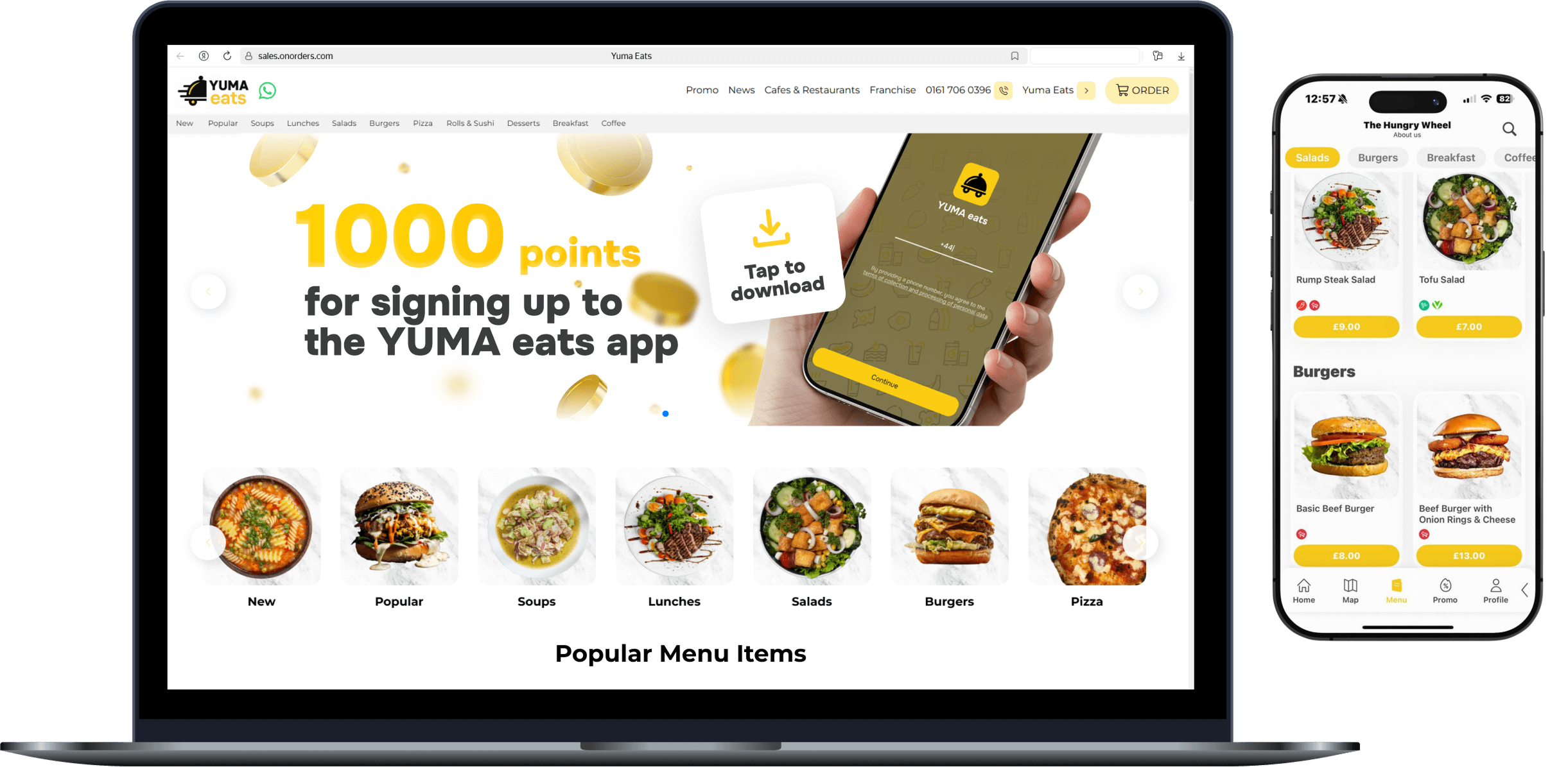
Take more orders directly
Give customers an easy way to order directly from your business, with your own online ordering system.
Being on more than one delivery app can help your restaurant reach more customers. But it can also create more work for the people actually running your service.
Deliveroo, Uber Eats and Just Eat each have their own systems for receiving and managing orders. If you’re using two or three platforms at the same time, that can leave your team switching between different tablets, notifications and menus throughout a busy shift, but it doesn’t have to work that way.
Delivery app management software can bring orders from multiple platforms into one place, giving your team a simpler way to manage delivery without constantly jumping between separate systems.
Here’s how it works, what it can help with and what to look for if you’re considering bringing your delivery apps together.
Why managing multiple delivery apps gets complicated
Adding another delivery platform can make commercial sense. It gives customers another way to find and order from you without requiring them to change the app they already use.
Operationally, however, every new platform can add another system for your team to manage.
Deliveroo recommends that businesses using its Live Orders system keep the interface open on a dedicated tablet or laptop, with notifications enabled and the device volume turned up so incoming orders aren’t missed. Uber Eats has its own Orders system for managing orders, deliveries and menus, while Just Eat sends incoming orders to its Orderpad for acceptance.
If you’re using several platforms, your team can therefore find themselves having to:
- Monitor several devices or interfaces
- Listen for different order notifications
- Keep track of orders coming from different places
- Update menus and availability across multiple platforms
- Re-enter orders into another EPOS or kitchen system
- Learn how each platform works
None of these jobs is particularly complicated on its own. The problem comes when they’re all happening at once.
During a quiet Tuesday afternoon, switching between different delivery apps might not cause much trouble. During a Friday evening rush, when you’re also serving customers in person and preparing existing orders, unnecessary steps quickly become more noticeable.
Can you manage Deliveroo, Uber Eats and Just Eat in one place?
Yes. This is where delivery app management software, sometimes called a delivery aggregator or middleware, comes in. Instead of staff monitoring each delivery platform separately, the software connects supported platforms and brings their orders into one central system.
Your customers don’t need to change how they order. Someone can still find you on Deliveroo and place their order through Deliveroo, another customer can order through Uber Eats, while someone else uses Just Eat.
The difference is what happens at your end. Rather than those orders arriving across several separate systems, they can be brought together into one place for your team to manage.
Delivery app aggregator vs EPOS integration
It’s worth understanding the difference between bringing your delivery apps together and integrating them with your EPOS.
A delivery app aggregator brings orders from multiple delivery platforms into one central interface.
An EPOS integration can take this further by connecting those orders with your wider till or kitchen setup.
Deliveroo describes middleware as a digital bridge between an ordering channel and a restaurant’s POS. Depending on the integration, this can include automatically synchronising orders, menus and stock information. Exactly what is automated depends on the systems you’re using.
For example, if you use delivery management software alongside an EPOS system that isn’t integrated with it, your team may still need to enter the order into the EPOS or kitchen system manually.
So when comparing different providers, don’t just ask whether they “integrate your delivery apps”, find out exactly what that integration includes.
What can you manage from one system?
The exact features depend on the provider you choose, but bringing your delivery platforms together can simplify several everyday tasks.
Manage your delivery orders in one place
The most obvious benefit is having one place to see incoming delivery orders. Instead of your team repeatedly checking separate systems for Deliveroo, Uber Eats and Just Eat, supported orders can appear within a central interface, which can create a much simpler process for staff during service.
They have fewer places to monitor and a clearer view of the delivery orders that need their attention.
Manage your menus centrally
Menus are another area where using several delivery platforms can create unnecessary admin.
Imagine you’ve introduced a new burger. If your menus are managed separately, someone may need to add its name, description, price, modifiers and availability to each individual platform. The same problem happens every time something changes. Prices go up, items are removed, new dishes launch, options and modifiers change, etc.
Central menu management allows you to make supported changes from one place rather than repeating the same job across several different systems.
Control item availability
Running out of something halfway through service is frustrating enough without having to remember everywhere that item appears.
Deliveroo, for example, provides its own stock controls for marking menu items as sold out or unavailable, with other platforms have their own menu-management processes.
With an integration that supports centralised menu and stock management, these changes can instead be controlled from the connected system.
That can be particularly useful during busy periods, when the person responsible for delivery orders probably has more important things to do than work through several different platforms.
Print delivery orders
Depending on your setup, incoming delivery orders can also be sent to a connected printer.
That gives the team preparing the order a physical ticket and can help bring delivery orders into your existing kitchen workflow.
The important thing is creating a consistent process – whether an order came through Deliveroo, Uber Eats or Just Eat should make as little difference as possible to the people responsible for preparing it.
What are the benefits of bringing your delivery apps together?
The goal isn’t simply to have fewer tablets on the counter. Instead, it is to remove unnecessary complexity from the way your team handles delivery.
Fewer systems for staff to monitor
Instead of repeatedly moving between different delivery interfaces, staff have one primary place to manage supported orders.
This is particularly valuable when your team is also dealing with customers at the counter, phone calls, collections and dine-in orders.
Lower risk of overlooking an order
When orders are spread across several devices, staff need to keep track of what’s happening on all of them.
Bringing orders together creates a clearer central workflow and reduces the number of separate places your team needs to watch.
Less repetitive admin
Making the same menu change multiple times isn’t a good use of anyone’s time.
Central management can reduce repetitive tasks and give managers one place to make supported changes.
Simpler staff training
Every additional system gives new employees something else to learn.
A central delivery workflow can make training simpler by reducing the amount of switching staff need to do during service.
A more consistent delivery workflow
Ultimately, it shouldn’t matter to your kitchen whether a customer prefers Deliveroo, Uber Eats or Just Eat.
The customer chooses their preferred ordering channel. Your team gets a consistent process for handling the resulting order.
Do you need to change your EPOS system?
Not necessarily.
Delivery app management and EPOS are related, but they’re not the same thing.
A delivery app management system can bring your marketplace orders together without necessarily requiring you to replace your existing EPOS.
There is an important distinction, though. If your delivery management software isn’t integrated with your existing EPOS, your team may still need to manually enter orders into the till or kitchen system. If you’re already reviewing your wider technology setup, it may therefore be worth looking at how your restaurant EPOS system or takeaway EPOS system handles delivery integrations.
With YUMA EPOS, orders from Uber Eats, Deliveroo and Just Eat can be processed through the EPOS alongside in-house and direct orders, creating a more connected workflow.
The important thing is to understand which parts of your process are being connected before you sign up.
What should you look for in a delivery app management system?
Not every restaurant needs exactly the same setup, so start with how your business currently handles delivery.
Some useful questions to ask potential providers include:
- Which delivery platforms can I connect?
- Can I manage orders from one interface?
- Can I update menus centrally?
- Can I control item availability across my channels?
- Can orders be sent to a printer?
- Do I need to change my current EPOS?
- What happens if my EPOS isn’t integrated?
- Do I need new hardware?
- Can I continue using my existing delivery platform accounts?
- How much does the system cost?
- Is there a minimum contract?
- Does the provider also support direct online ordering?
That last question is particularly important if you’re looking at your longer-term delivery strategy.
Managing marketplace orders more efficiently solves the operational challenge of being on several delivery apps, but it doesn’t change the fact that those orders are still being placed through third-party marketplaces.
Direct online ordering tackles a different problem by giving customers a way to order directly from your business.
If you’re deciding how these channels should work together, we’ve looked at what UK restaurants actually pay for delivery apps compared with direct ordering.
You can also read our guide to what to look for in an online ordering system if you’re reviewing your wider ordering setup.
Manage Deliveroo, Uber Eats and Just Eat with YUMA
YUMA’s delivery integrations are designed to make managing multiple delivery platforms simpler.
Rather than treating Deliveroo, Uber Eats and Just Eat as completely separate parts of your operation, YUMA can bring delivery orders into the same wider workflow used for your other orders.
For businesses using YUMA EPOS, orders from supported delivery platforms can be processed through the EPOS alongside in-house and direct orders.
That means your restaurant can bring together:
- Deliveroo orders
- Uber Eats orders
- Just Eat orders
- In-house orders
- Collection orders
- Direct online orders
For takeaways in particular, bringing these channels together can remove some of the manual work involved in managing a high volume of orders during peak periods. You can see more about how this works on our EPOS system for takeaways page.
Delivery integrations can also sit alongside YUMA Online Ordering, giving customers a way to order directly from your business as well as through the marketplaces they already use.
The two solve different problems.
Delivery app management makes third-party delivery platforms easier to manage.
Direct online ordering gives customers another way to order from you directly.
You don’t necessarily have to choose between them.
Delivery marketplaces can continue to provide reach and customer discovery, while your own ordering channel gives existing customers another route to order from you.
Bring your delivery orders together
Using Deliveroo, Uber Eats and Just Eat doesn’t have to mean managing three completely separate workflows.
Bringing your delivery platforms together can give your team fewer systems to monitor, reduce repetitive admin and create a more consistent process for handling delivery orders during busy service.
And if you’re also taking orders in-house or through your own website, connecting those channels with your wider EPOS setup can simplify things further.
Using more than one delivery platform?
See how YUMA can bring your delivery, in-house and direct orders into a more connected workflow.
Explore YUMA’s EPOS for takeaways or get in touch with YUMA.