Table of contents
Keep your kitchen running smoothly
Send orders straight to the kitchen, reduce mistakes and help your team serve guests faster with YUMA KDS.
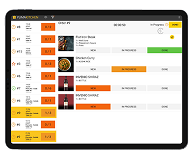
Not all point-of-sale systems are built the same, even if they look similar on the surface. A lot of what’s sold as “POS for hospitality” started life as retail software — built to scan a barcode, take a payment, and print a receipt — with a hospitality skin added on afterwards. It can work, in the way a borrowed tool works: fine for the parts it was designed for, awkward everywhere else.
Here’s what a system actually built for hospitality needs to do differently, and why it matters once service gets busy.
Why a retail till doesn’t quite fit
Retail POS was built around a simple shape of transaction: a customer picks up items, brings them to a till, pays, and leaves. One customer, one basket, one payment, done.
Hospitality doesn’t work like that. A table might order starters, then mains, then desserts, over the course of an hour, with drinks arriving separately, one guest paying for everyone and another splitting three ways, and the kitchen needing to know exactly when to fire each course so nothing arrives cold or early. None of that maps neatly onto “scan, pay, done” — which is exactly where a retail-derived system starts to show the seams.
What hospitality POS actually needs to handle
A system genuinely built for hospitality is designed around these needs from the ground up, not bolted on afterwards:
Course and timing management. Sending starters to the kitchen now and mains twenty minutes later, automatically, rather than a server having to remember and hold orders back manually.
Splitting and combining bills. Three friends splitting one meal three ways, or one table paying for two separate parties, handled in a few taps rather than a manual workaround at the till.
Table and tab management. Keeping track of what’s been ordered, what’s outstanding and what’s been paid, per table, across an evening that might run for hours — not a single transaction closed the moment it’s rung through.
Kitchen integration that matches real service. A proper kitchen display system that reflects actual course pacing and covers, not just a ticket printer spitting out orders in the sequence they arrived.
Tipping and service charge, done properly. Handling discretionary service charge, tronc, and card tips correctly and transparently — an area that causes real friction when it’s an afterthought rather than a core feature, and one that’s now a legal requirement too: the Employment (Allocation of Tips) Act 2023 requires UK hospitality employers to pass on tips fairly and keep clear records of how they’re allocated.
Speed under real pressure. Built to stay fast and reliable during the exact moments retail tills rarely face — a Friday dinner rush, a beer garden on a sunny bank holiday, a queue that isn’t going anywhere.
Where the mismatch actually costs you
None of this is really about missing features on a spec sheet — it’s about what happens during a busy service. A retail-derived system without proper course timing means staff manually managing what the software should be handling automatically. Clunky bill-splitting means a queue building at the till while someone works out who owes what. A ticket system that doesn’t reflect real kitchen pacing means dishes arriving in the wrong order, or cold. Individually, these look like small frictions. Across a full Saturday night, they add up to slower service, more mistakes, and a noticeably harder shift for your team.
Whether you’re running a café, a full-service restaurant or a pub or bar, the shape of a hospitality service is different enough from retail that the software running it needs to be built for that shape specifically, not adapted to fit it after the fact.
The takeaway
The difference between hospitality POS and a retail till adapted for the job isn’t cosmetic — it shows up in exactly the moments where you can least afford friction: mid-service, under pressure, with a full room. If a system wasn’t built around courses, splitting, table management and kitchen pacing from day one, it’s worth asking how much of that has genuinely been solved, rather than just squeezed in.
Want to see hospitality-built POS in action? Book a demo with YUMA and put it through a real service scenario.